
Indoor Recreational Activities Examples
Indoor Recreational Activities Examples
Indoor recreational activities in Egypt are best suited to the real daily need when it is active, social and mentally fresh, not in the heat, traffic, dust or late-night plans. A well-structured home-based routine works well to bring movement and focus, laughter and quiet reset together. For families, that could be balloon relays, charades, paper airplanes and a dance party. For adults, it might be yoga, board games, light exercise and creative challenges to fit a small apartment. The main advantage is flexibility: you can use the same setup for younger kids, older kids, couples and solo leisure and not a lot of money. Of course, if you ever want a change of pace from active home routines, you can always try something like Spinbetter casino login – for a different kind of mental engagement.
In Egypt, the topic matters because people want something practical for afternoon and evening activities, weekends where their exams are over, they visit family or the weather can get rainy all the time and the outside environment is upended. Good home-based play is not just a temporary refuge in a bad weather situation. It can be part of a better routine, especially when space is limited and everyone still needs movement in their life and connection to use free time properly. The best are simple, repeatable and have the best way of starting within minutes.
The biggest mistake is to divide home entertainment into a single category. It is far more useful to split it up by purpose. Some options boost energy. Some improve coordination. Some lend mindfulness. Some help kids’ imaginations.
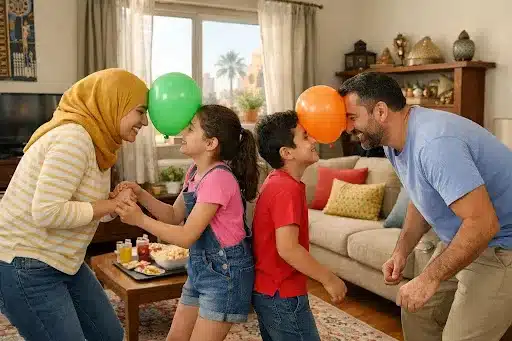
Indoor Activities, Outdoor Activities and Exercise For Kids and Adults
If your goal is shared family laughter, you can play hot potato, the hokey pokey or charades. If calm concentration is the focus, sorting cards, building wooden puzzle towers, mirror drawing, or a tissue balancing challenge can be very good. This distinction is important as the same room can be a small sports area, a creative studio or a peaceful learning environment depending on how it is presented.
The problem is that the best plan is usually the least setup friction.
Recreation Formats By Mood, Age, And Space
| Format | Best for | Typical setup | How it works |
| Movement play | High energy after school or work | Balloon, beanbag, tape lines, soft ball | Burns energy without needing much room |
| Thinking play | Quiet evenings | Board games, paper, string | Builds focus and social interaction |
| Creative play | Weekends and family time | Cardboard, paper plates, costume box | Supports imagination and storytelling |
| Calm reset | Stressy days | Yogga mat, bottle of water, soft music | Helps attention and mindfulness |
A smart home routine mixes two or three of these, instead of only one style.
Activities With Toys For Kids That Do More Than Fill Time
The most interesting activities for children are the ones that are fun but do build something underneath. That “something” can be balance, rhythm, patience, teamwork, or problem-solving. Parents in Egypt don’t necessarily need more toys as much as a better use of what is already at home. Try these examples of indoor fun:
- Balloon tap relay – Keep the balloon up in the air while moving across the room from one side to the other. This helps you with timing and body control.
- Beanbag or bean toss – It is to throw a beanbag, rolled sock or even a soft bean-filled pouch and aim for a box. Change the distance to scale difficulty.
- Paper airplanes test lab– Fold several designs then label them and compare flight distance, height and landing style. This is simple but it improves coordination very quickly.
- Costume story round – Pull one costume piece or random item from the box and make a story around it. This is great for kids’ imagination.
These ideas work in this sense, as younger kids respond to clear rules and clear boundaries and also to clear goals for action and role changes, whereas older children have a lot of fun with scoring systems, timed rounds and role changes. Children of all ages have a habit of staying involved longer when they follow the rules instead of just obeying them.
Board Games, Card Play And Other Table Wins
Not every session has to be run or jumped at. Some of the best home habits come from slow-paced fun games that form a structure and conversation. Board games are great because they teach players how to take turns, how to plan and how to handle emotions. A card session would do it too, but with less setup and better storage. There are some good table-based games for home leisure:
- Board games where players are learning strategy, patience and cooperative decision making
- Paper plates games where players stack or balance items
- String puzzles that demand patience and experimentation
A loud round of movement play is great but not every hour should feel like a mini sports hall.
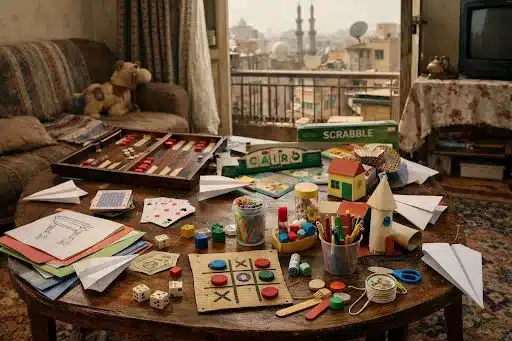
Physical Activities Without A Full Sport Setup
A lot of people think great indoor fun or physical activity needs equipment. Most of the time they don’t. A simple and well-organized routine can be laid out with walls and floor markings, a hoop made from tape, a soft ball and a music playlist. The aim is not to recreate an outdoor field. Movement is easy to start with:
- taped hopscotch on the floor
- shadow footwork patterns
- dance combinations with stop-and-go commands
- bowl rolls towards targets
- skip steps between cushions
- flows for flexibility and breath control
This type of exercise is ideal in Egypt when it is hot and outdoor play can feel tiring before it is enjoyable. Good indoor practice will leave people in good spirits and not tired and frustrated.
A Simple Weekly Plan For Homes In Egypt: Hot Potato, Balloon, Bowl, Mirror
| Day | Category | Materials | Best for |
| Monday | Movement | Tape, Soft ball | Families |
| Tuesday | Calm focus | Card set, Paper, Mirror | Solo or pairs |
| Wednesday | Music and dance | Speaker, Open floor space | Kids and adults |
| Thursday | Creative build | Cardboard, Bottle caps, String | Family time |
| Friday | Group laughter | Charades, Hot potato, Costume items | Guests or larger households |
| Saturday | Stretch and reset | Yoga mat, Towel, Water bottle | Adults or mixed ages |
| Sunday | Free-choice challenge | Box targets, Hoop marks, Bean toss | Everyone |
This type of rotation works because it cuts boredom in half and creates inspiration. It also removes the daily question of what to do. People join more easily when the plan is laid out.

Dance, Yoga and Musical Routines
It doesn’t require much explanation and kids love it because the entry barrier is so low. And dance is also useful for adults in that it mixes exercise and release. You don’t really have to be good at it. You only need enough space to move safely. Yoga is different. It is slower, more internal and better when the house is overstimulated. In our homes, for example, matching high-energy movement with a calmer sequence can have much better rhythm than one extreme. Ten minutes of musical motion followed by five minutes of breathing and stretching can bring the group together without hurting fun. That contrast is especially relevant during school weeks, busy work hours, and family meetings when energy levels are uneven.
Rainy Day And Small-Space Ideas That Still Seem Fresh
It can be a rainy afternoon or dusty evening that kills the idea of going out at all, but it doesn’t have to kill the day. Small-space entertainment takes off when the aim is clear. People lose interest faster when the plan is too vague. Try this mix for small rooms:
- Tissue balance walk: Put a tissue on the head and cross the room without dropping it.
- Roll a soft ball and knock down a line of light plastic bottles.
- Paper plates stepping path: Create a path and assign rules: one foot, two feet, spin, clap.
- Bean or sock toss: Aim into a bowl or box with different point values.
- Object memory tray: Show several household items, cover them, then recall as many as possible.
These are some of the most active indoors scenarios with no chaos. They are also easy to re-imagine and recycle with the same rules—the next step, which is how to get more use from the same material.
How Do I Keep Younger And Older Kids Engaged?
Many families have no time to do this. An easy game for a six-year-old may be too easy for a preteen. A format that works for older kids can lose younger kids in a few minutes. The answer isn’t to create separate worlds in every case. It is to build layers of work. For younger kids, go for simpler instructions, shorter rounds, and visible targets. For older kids, add more time pressure, point systems, role reversal, or design tasks. The same paper airplanes concept can become easy-to-do fold fun or a real testing of distance, accuracy, and aerodynamics. The same charade round can be themed, timed, or team-based. Children of all ages are more active when they can change a rule, create a variation, or choose the next task. That shared ownership is often more important than the materials.
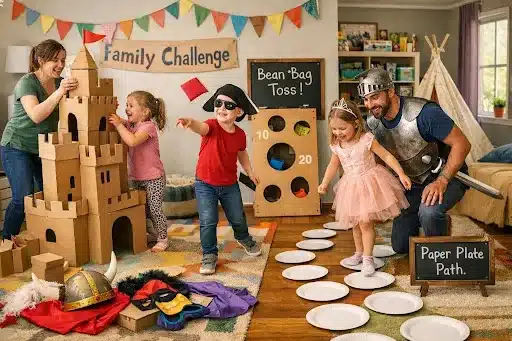
A Practical Home Kit For Great Games And Indoor Fun
| Item | Use case | Cost | Notes |
| Balloon | Relay, balance, keep-up play | Very low | Safer than a hard ball in tight spaces |
| Soft ball | Target games, rolls, catches | Low | Best for motion and coordination |
| Cardboard | Towers, props, creative construction | Very low | Great reuse value |
| Paper plates | Stepping markers, balancing tasks, crafts | Low | Good for adaptable rules |
| Beanbag or rolled socks | Toss games | Very low | Easy substitute for store-bought items |
| Mirror | Copy play, posture checks | Existing item | Useful for movement games |
| Bowl or box | Scoring target | Existing item | Turns simple throws into a real challenge |
The best home kit is not fancy. It is flexible. One box with these items can support movement, calm play, creative work, and group laughter for months.
What Makes a Recreational Activity Worth Repeating?
And that’s the benchmark to be measured. Not “Was it cute once?” but “Will anyone ask to do it again?” Successful ideas are usually consistent with the following things: they have a good setup, clear rules, easy variation, and a satisfying end. That’s why charades are still being played; target tossing, hot potato, and dance are still being played. They get people involved in something quickly. They also let the household shift the mood and tone up and down. Some days people want a full burst of motion. Some days they would prefer a slower, more contemplative format. A good home routine lets you have both.
FAQ
What Are The Best Choices For Families In Egypt?
The best are the ones that can handle heat, small space, and mixed age groups well. Balloon relays, paper airplanes, target tosses, and short dance rounds are good and cheap to do as they are flexible and repeatable.
How Can I Make Play At Home Less Repetitive?
Rotate by purpose instead of material. You move one day and then practice the next day and then the third day. Even the same box can support very different sessions.
Are These Options Useful For Adults Too?
When the framing changes, many formats are good for adults. Light exercise circuits, bowl targets and music-based movement can be calming and social or energizing as you put them to work.
What Should I Go For At First?
I begin with almost nothing: a balloon, a soft ball, paper, tape and a box. Only add a lot of stuff after you know the household actually returns to it?